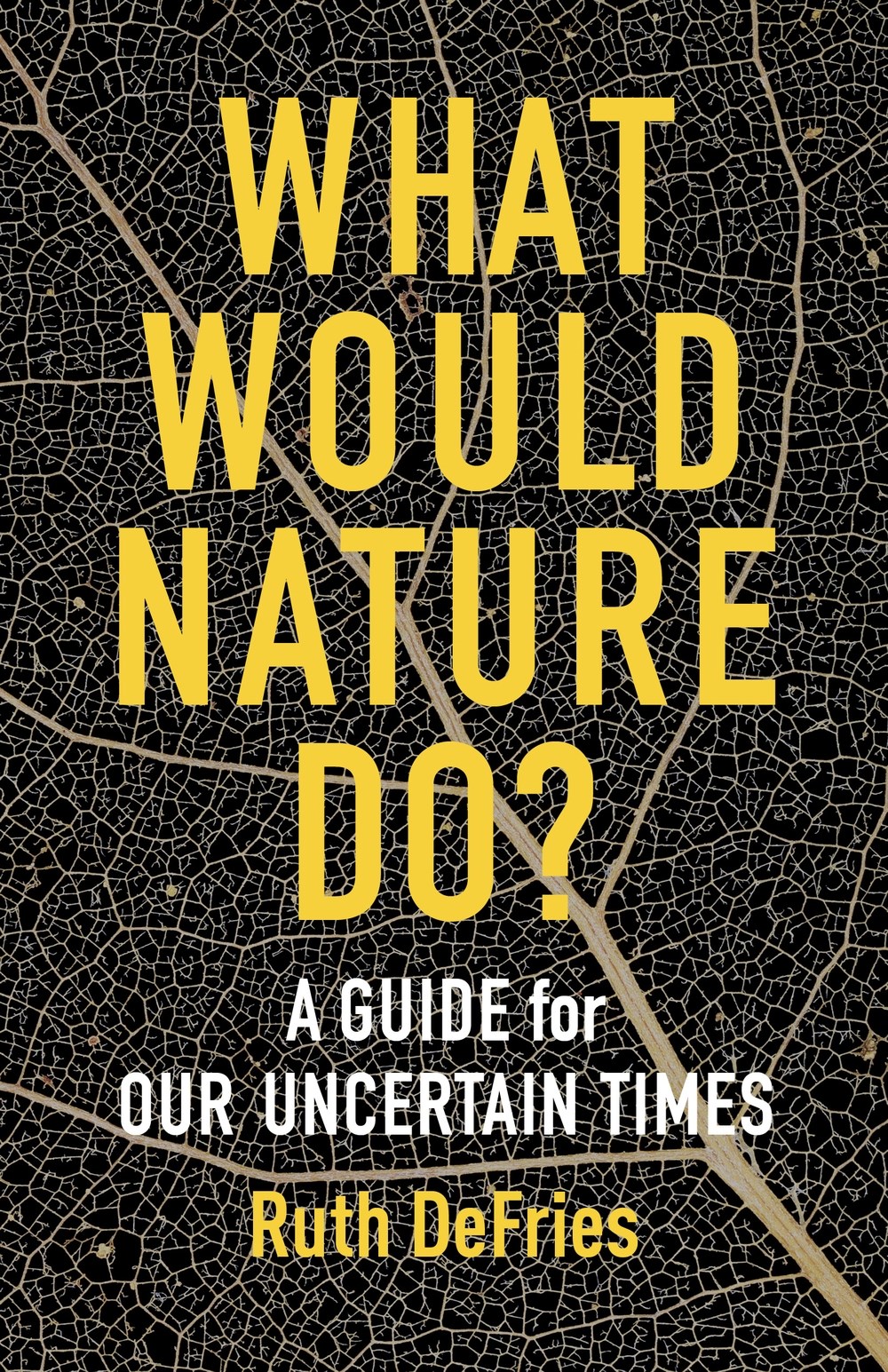
“This is a stunning book in every way that a bibliophile or collector can imagine, and it’s an inspirational book in every sense that a citizen scientist or a professional ecologist can wish for.”—The Guardian

Why is the US Always at War?

A powerful portrait of the greatest humanitarian emergency of our time, from the director of Human Flow

Bah Humbug

Scroogenomics illustrates how our consumer spending generates vast amounts of economic waste—to the shocking tune of eighty-five billion dollars each winter. Economist Joel Waldfogel provides solid explanations to show us why it’s time to stop the madness and think twice before buying gifts for the holidays. Wired.co.uk looks at the issues raised in Waldfogel’s book and discusses the economic and societal consequences of gift-giving.

Paul Milgrom wins The Nobel Prize for Economics for his work on Auctions

Columbia University Press author Paul Milgrom has been awarded the Nobel Prize for Economics, with Robert Wilson, for his work on auctions.”This year’s Laureates, Paul Milgrom and Robert Wilson, have studied how auctions work. They have also used their insights to design new auction formats for goods and services that are difficult to sell in a traditional way, such as radio frequencies. Their discoveries have benefitted sellers, buyers and taxpayers around the world.”
 
In Discovering Prices, Paul Milgrom—the world’s most frequently cited academic expert on auction design—describes how auctions can be used to discover prices and guide efficient resource allocations, even when resources are diverse, constraints are critical, and market-clearing prices may not even exist. Economists have long understood that externalities and market power both necessitate market organization. In this book, Milgrom introduces complex constraints as another reason for market design. Both lively and technical, Milgrom roots his new theories in real-world examples (including the ambitious U.S. incentive auction of radio frequencies, whose design he led) and provides economists with crucial new tools for dealing with the world’s growing complex resource-allocation problems.


Beethoven, A Life. Celebrate the 250th anniversary of Beethoven’s birth

The authoritative Beethoven biography, endorsed by and produced in close collaboration with the Beethoven-Haus Bonn, is timed for the 250th anniversary of Beethoven’s birth.

With unprecedented access to the archives at the Beethoven House in Bonn, renowned Beethoven conductor and scholar Jan Caeyers expertly weaves together a deeply human and complex image of Beethoven—his troubled youth, his unpredictable mood swings, his desires, relationships, and conflicts with family and friends, the mysteries surrounding his affair with the “immortal beloved,” and the dramatic tale of his deafness. Caeyers also offers new insights into Beethoven’s music and its gradual transformation from the work of a skilled craftsman into that of a consummate artist.

Roger Penrose wins the Nobel Prize for Physics

Princeton University Press author Roger Penrose, has been awarded the Nobel Prize in Physics for his work on black holes. One half of the Prize was awarded to Penrose, with the other half shared by Reinhard Genzel and Andrea Ghez. According to the Royal Swedish Academy of Sciences, Penrose was awarded the Prize, “for the discovery that black hole formation is a robust prediction of the general theory of relativity.”

The Academy announcement notes, “Roger Penrose used ingenious mathematical methods in his proof that black holes are a direct consequence of Albert Einstein’s general theory of relativity…ten years after Einstein’s death, Roger Penrose proved that black holes really can form and described them in detail; at their heart, black holes hide a singularity in which all the known laws of nature cease. His groundbreaking article is still regarded as the most important contribution to the general theory of relativity since Einstein.”

Penrose is one of the world’s foremost theoretical physicists and the winner of the Albert Einstein Medal for his fundamental contributions to general relativity and cosmology. He is the bestselling author, with Stephen Hawking, of The Nature of Space and Time (Princeton). With PUP, he is also the author of Fashion, Faith, and Fantasy in the New Physics of the Universe. He has contributed forewords to: The Best Writing on Mathematics 2013, edited by Mircea Pitici; Einstein’s Miraculous Year: Five Papers That Changed the Face of Physics, by Albert Einstein and edited by John Stachel; and Fearful Symmetry: The Search for Beauty in Modern Physics, edited by A. Zee. Penrose’s other books include Cycles of Time: An Extraordinary New View of the Universe and The Road to Relativity: A Complete Guide to the Laws of the Universe (both Vintage). He is the Rouse Ball Professor of Mathematics Emeritus at the University of Oxford and lives in Oxford, England.


Critique and Praxis by Bernard Harcourt, Can Critical Theory Change the World?

“Can critical theory change the world?” In this video, Bernard E. Harcourt offers a vision of critical theory in the twenty-first century by asking not “What is to be done?” but rather “What more can I do? What work is my praxis doing?” Harcourt is the author of Critique and Praxis , in which he challenges us to move beyond decades of philosophical detours and harness critical thought to the need for action.